

Pure Puritan
Part Two
In today’s world self-help gurus dispense advice on everything from productivity to happiness, and Cotton Mather might seem an unlikely source of inspiration for the industry, yet this 17th-century Puritan minister could be considered as having laid the groundwork. He embodied the influencer archetype over 300 years before it was even a thing. Mather, with his prolific output of pamphlets, passionate pronouncements on moral living, and blend of religious faith with scientific curiosity, became a central figure in colonial America. While his role in the Salem Witch Trials casts a long shadow, Mather’s ability to leverage the power of the press to shape public opinion offers a fascinating parallel to the rise of the modern blogosphere.
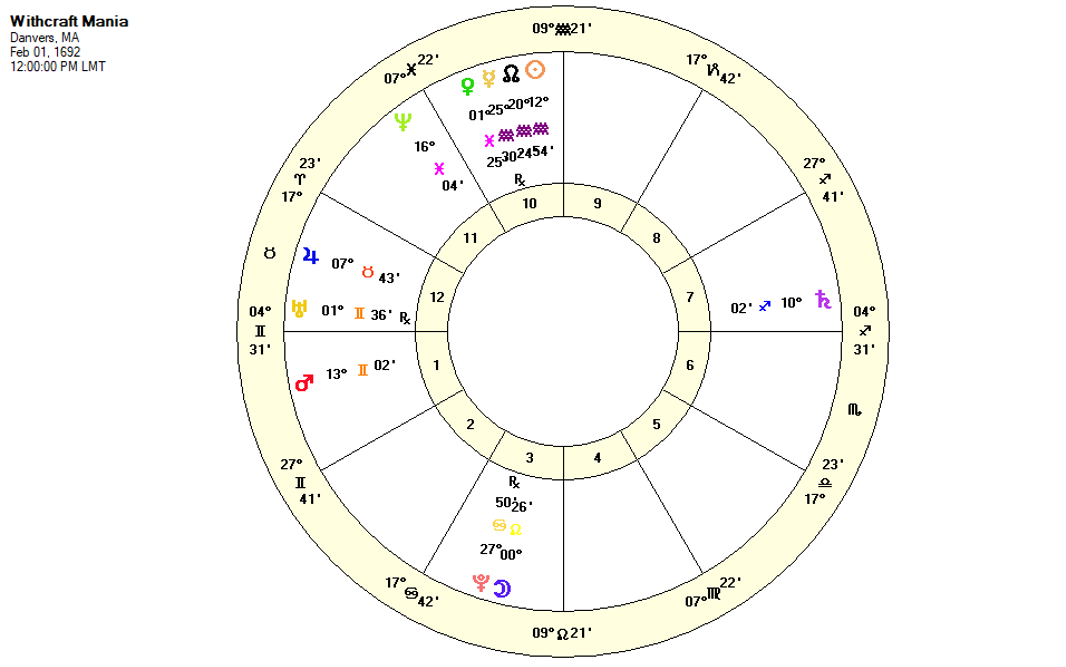
The word “afflicted,” once a common astrological term signifying a planet with negative influences, has witnessed a recent revival. This is a troubling trend that in some ways echoes what was referred to as “spectral evidence” during the Salem Witch Trials. Back then, young girls claimed to be “afflicted” by witchcraft. Even today some astrologers refer to a planet as being “malefic,” a term with disturbing parallels to witch mania. Just as the Salem accusers blamed unseen forces, some modern astrologers might be tempted to see a “cursed” planet behind every misfortune. This approach, like the Salem accusers, risks scapegoating the wrong “evil doer,” confusing cause and effect. In the witch trials, a woman named Tituba, was wrongly accused and serves as an example. We’ll explore her story further on, but for now, the key takeaway is the danger of attributing misfortune to unseen forces, be it astral evidence, or spectral evidence.
Disclaimers like “For Entertainment Purposes Only” were once a shield for practitioners of divination – astrologers, tarot readers, palmists. These disclaimers protected them from taking responsibility for client decisions based on readings. However, the tide has turned. Today, some practitioners project an air of certainty and self-importance that would rival the Wizard of Oz, and no disclaimer within earshot. This boldness, while perhaps good for business, carries a risk. When pronouncements are mistaken for truth, as with “spectral evidence” in the case of Salem, people make decisions that can be dangerous. The anecdote told regarding Titituba was that she was supposedly merely “entertaining” the children. but ironically this isn’t what saved her from the court [spoil alert].
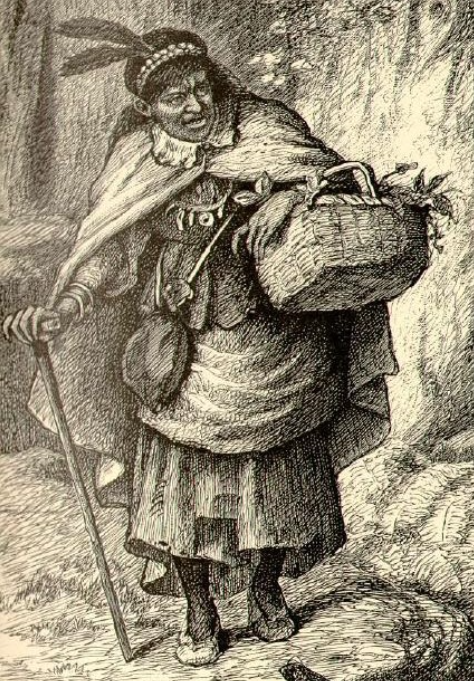
Illustration of Tituba by John W. Ehninger, 1902
Cotton Mather’s writings may have inadvertently fueled the fires of hysteria in Salem. He described “strange behavior” of children in Boston as “a disease of astonishment,” igniting fear and suspicion in his readers. More than that critics argue that he helped light the match that ignited the fire around the very stake to which no witch was ever burned (because that part of the narrative became an apocryphal story, perpetuating the myth). If not witchcraft, then what was to likely cause of the symptoms that afflicted the children? Research suggests a more likely culprit was ergot poisoning, a condition with symptoms similar to those described by Mather. In this light, the “coincident actors” – the accursed witches – become tragic victims of misunderstanding, not perpetrators of evil. The “malefic” planets ought to be grateful they live at a safe distance from Earth lest they suffer a similar “fate.” A well-known adage of a skeptical mind says, “correlation is not causation.” This phrase reminds us to look beyond initial assumptions, a lesson as relevant today as it was in 1692.

Interestingly, the Salem Witch Trials coincided with a period of significant planetary alignments in astrology. This coincidence raises the question: are there echoes of similar mass hysteria in our own time? Only time will tell, but the correspondence of Jupiter in conjunction with Uranus provides fascinating historical corollaries to big changes. From Nicholaus Copernicus to Isaac Newton, the Scientific Revolution was well underway, individual lives were changing at an accelerated rate, and in ways never seen before in history. Human progress was in short, making UNBELIEVABLE headway. No wonder people’s sentiments became vulnerable to distortion in 1692, and were amplified in unexpected ways and to such surprise and astonishment that future generations discuss the events that happened in Salem to this day. The world was sitting on the cusp of The Enlightenment and at the eve of the Age of Reason, but you wouldn’t have known this if you were the one accused of afflicting someone with witchcraft, and waiting your turn at the gallows or being pressed to death by stone.
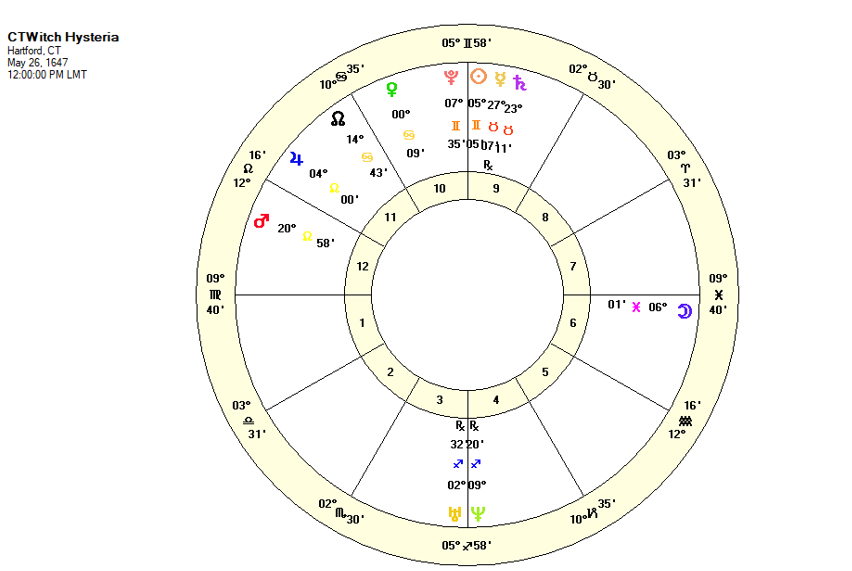
Cotton Mather, a man respected for his scientific pursuits, also believed in the “spectral presence” of witches. His writings, based on personal observation, lent legitimacy to the concept. Even today, some confuse personal beliefs with evidence, as seen in movements like QAnon. However, science itself is constantly evolving, with new paradigms challenging old assumptions. Thomas Kuhn wrote The Structure of Scientific Revolutions, and explored this concept in what he called paradigm shifts. What seems scientific today might be questioned in the future, so a healthy dose of skepticism remains crucial, and well, informs the scientific method. Perhaps Cotton Mather’s story serves as a reminder that even well-intentioned scholars and people of science can be blinded by their own beliefs.
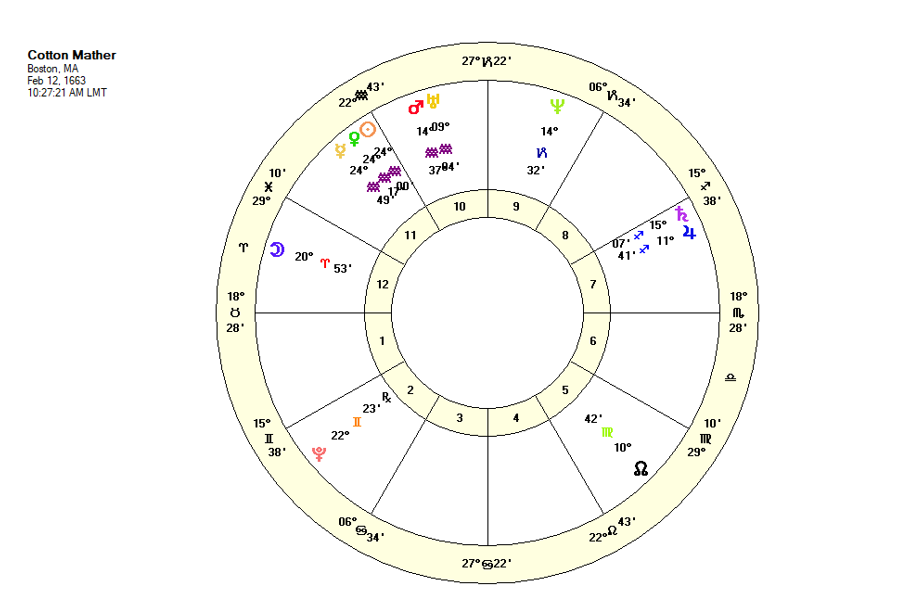
Cotton Mather’s prolific writing career and need for public approval suggest a deep-seated desire for recognition. Perhaps this stemmed from the relationship he had with his successful father. A relentless drive, while fueling his productivity, might have also contributed to a sense of self-importance. An extremely close line up between the Sun, and the inner personal planets (idealism) in the 11th house, and the Moon in the 12th house (introspection) combines the Sun in Aquarius with the Moon in Aries, always a Mary Poppin’s quality. We might call this combination the supercalifragilisticexpialidocious effect.
Natal Pluto trines Cotton’s Sun along with his inner core planets, empowering his sense of identity and self-expression. The Jupiter-Saturn conjunction tightly aspects this Solar construct as well by quintile. There can be little doubt he was a genius.
Cotton Mather’s personal life was marked by both joy and sorrow. He married three times, fathered fourteen children, yet endured the loss of two wives and most of his children during his lifetime. These personal tragedies coincided with a period of self-doubt and introspection. While his father’s influence is well-documented, Mather’s relationship with his mother remains a mystery. However, astrological interpretations (the Sun and inner planets quindecle the Nodal Axis) suggest this bond might have been a significant force in shaping his life, perhaps even more than his father’s. As the Age of Reason melded into the Age of Anxiety, it only seems reasonable that psychology would begin to look for influences that were not extraterrestrial, to find some relational correspondence in the environment, but we weren’t there yet. Astrology had a long way to go!
The Salem Witch Trials bear an unsettling resemblance to McCarthyism, a period in American history where people were accused of communist sympathies with little evidence. Arthur Miller’s play “The Crucible” drew direct parallels between the 1956 episode and the Salem Witch Trials. Both eras were fueled by fear and suspicion, leading to devastating consequences. Interestingly, both eras coincided with the Jupiter-Uranus conjunction.

Cotton Mather’s legacy remains complex. While his writings on witchcraft contributed to a dark chapter in history, his broader influence as a scientist and communicator foreshadows social media influencers. The Salem Witch Trials serve as a stark reminder of the dangers of mass hysteria, a cautionary tale that resonates even today. The echoes of the Salem Witch Trials can be heard in our own time, from the spread of misinformation online to the scapegoating of the “other” in the realm of politics. Mather’s story compels us to approach information with a critical eye and to challenge pronouncements that rely on fear or speculation rather than evidence. Cotton Mather’s life and work offer a fascinating case study in the intersection of science, religion, and astrology. While the astrological interpretations explored here are open to interpretation, they raise intriguing questions about the forces that shape our beliefs and actions. Perhaps the enduring lesson of Mather’s story is the importance of healthy skepticism, both in the pronouncements of others and in our own biases.
- Footnote 45 from the Wikipedia page on the Salem Witch Trial:
Caporael, Linnda R. (1976). “Ergotism: The Satan Loosed in Salem?”. Science. 192 (4234): 21–26. Bibcode:1976Sci…192…21C. doi:10.1126/science.769159. JSTOR 1741715. PMID 769159. Archived from the original on June 27, 2022. Retrieved June 27, 2022.

 Hudson Valley Astrologer
Leave a comment