
“Self-reflection, or… the urge to individuation, gathers together what is scattered and multifarious and exalts it to the original of the One…”
~ Carl Jung
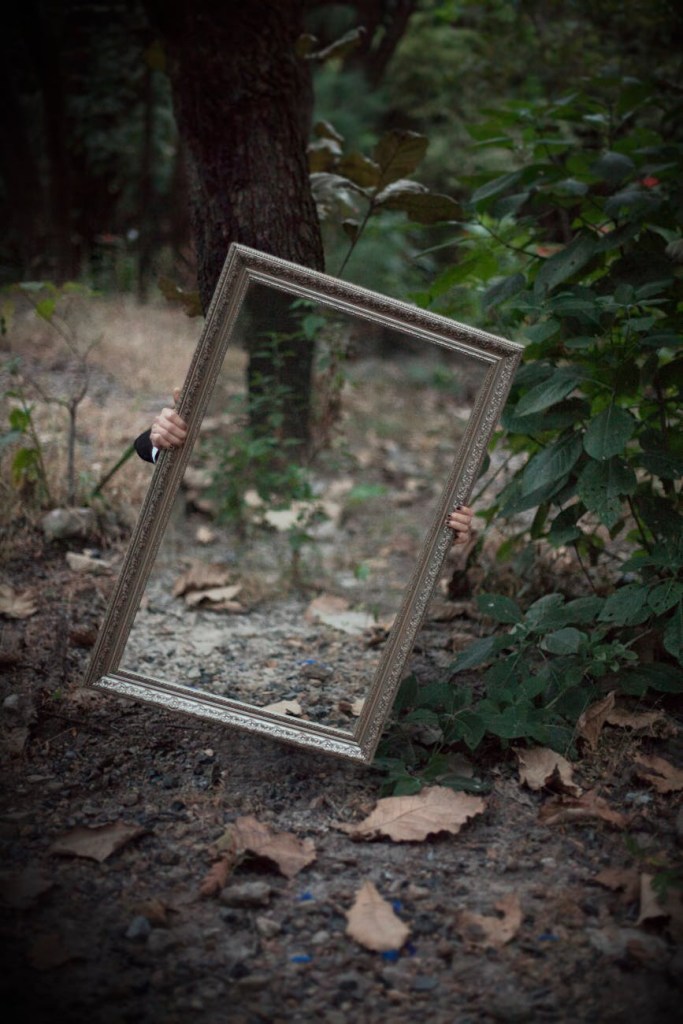
“As within, so without,” is an ancient Hermetic maxim that I first heard on Pink Floyd’s epic Dark Side of the Moon album. There are so many great songs on that record, in fact they’re all great, which makes it one of my all-time favorite albums. The song this maxim refers to is called Us and Them, a tribute that boils down to how we shape our identity (Me and you, black and blue, etc.), determine a life direction (Up and down), and battle class warfare (Down and out; with, without). One lyric from the song recognizes our cyclical nature: “and in the end it’s only round and round and round,” and echoes the lyrics of another progressive rock band from back in the day, YES, who published their album Roundabout (1971) at about the same time as Pink Floyd’s Dark Side of the Moon (1973). Questions of Time and Measure that had confounded spiritual seekers, sociologists, and songwriters for aeons are embedded in those brilliant works, and prefigure the more brilliant work of Patrizia Norelli-Bachelet, who answered those questions for the first time ever, when she published her book The Gnostic Circle, (1975).
My one overriding daily habit is to write, and read. It’s become a bit much if I am to be honest. The gardens, garage and the basement in my house would agree since they’re increasingly in a state of being unkept. Like the world itself I suppose, in the state of dissolution that it is in.
Nevertheless, I write to help myself find a thread of coherence in life, one that I hopefully can grab and hold onto for dear life, from which to weave an entirely new fabric — a new perspective.
Now that I think of it, part of this new way might in fact emerge as soon as I do get around to cleaning up the garage, tending to the basement and eliminating the poison ivy that is encroaching into my yard. I am reminded of an old saying that describes disorderliness as being a projection onto our living space, or stated inversely, our living space is but a reflection of our mind. Jung’s view is actually rooted in fragmentary thinking, which reflects a crystallization of mind, prone to shattering. I see myself going in another direction.
HVA
💚🍀
 Hudson Valley Astrologer
Leave a comment